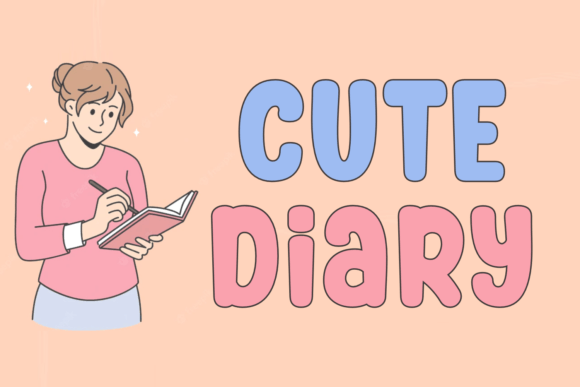
Cute Diary: A Friendly Display Font for Handmade Brands
If you’ve ever spent hours searching for a font that feels warm, approachable, and *just right* for your handmade product—whether it’s a candle label, a printable planner page, or a rustic wedding welcome sign—you’ll understand why Cute Diary has become my go-to display font. It’s not overly cutesy or childish; instead, it balances natural flow with gentle personality—like handwriting that’s been carefully refined for clarity and charm. As a small shop owner who designs SVG files, printable kits, and physical product labels, I need fonts that look great both on screen and in print—and that cut cleanly on my Cricut and Silhouette machines. Cute Diary delivers exactly that.
Why Cute Diary Fits Real Craft Projects So Well
Cute Diary is a display font—meaning it shines brightest at larger sizes, where its expressive curves and friendly proportions truly breathe. Its letterforms have soft terminals, subtle contrast, and an organic rhythm that avoids stiffness without sacrificing legibility. That makes it ideal for short, high-impact text: names on baby shower invites, boutique tags for handmade soaps, seasonal phrases on farmhouse-style wall art, or even playful slogans on tote bags and mugs. Unlike some script fonts that blur together at small sizes, Cute Diary holds up remarkably well down to 14–16pt on printed cards and packaging—especially when used with generous spacing and clean backgrounds.
Where You’ll Use Cute Diary Most Often
I reach for Cute Diary first when designing:
- Candle and bath product labels—its warmth reinforces “hand-poured,” “small-batch,” and “naturally scented” messaging;
- Wedding stationery, especially welcome boards, seating charts, and digital RSVP cards—where guests respond to sincerity over formality;
- Printable planner inserts and habit trackers—the font adds visual interest without overwhelming daily writing space;
- Stickers and die-cut vinyl decals—its open counters and consistent stroke weight ensure crisp cuts and strong adhesion;
- Holiday packaging and gift tags—think “Merry & Bright” on kraft paper boxes or “Happy Birthday!” stamped onto fabric banners;
- Digital downloads sold on Etsy, like editable Canva templates or layered PSD invitations—Cute Diary gives buyers instant brand cohesion.
It also works beautifully for social media graphics—especially Instagram Story highlights or Pinterest pins—because its friendliness draws the eye without shouting. And yes, it’s versatile enough for web design use (via @font-face or embeddable platforms), though always test rendering across devices before finalizing client mockups.
Pairing Cute Diary Thoughtfully
Like any strong display font, Cute Diary benefits from smart pairing. I most often combine it with a clean, neutral sans serif—think Montserrat, Poppins, or Lato—for body text, pricing, or ingredient lists. This contrast keeps the focus on Cute Diary’s charm while ensuring information stays readable and professional. For more vintage or romantic projects, I’ll pair it with a delicate serif like Playfair Display or Cormorant Garamond—but only for headings, never long paragraphs. Avoid stacking multiple decorative fonts; Cute Diary already carries expressive weight, so let it lead.
Practical Tips for Cutting, Printing & Selling
When prepping Cute Diary for cutting machines: convert text to outlines in Illustrator or Inkscape, then simplify paths slightly if needed—its natural flow means fewer anchor points than tightly wound scripts, which helps prevent jagged edges on small stickers or intricate tags. For printed cards or packaging, use a minimum size of 18pt for headlines and avoid ultra-thin paper stocks that might let ink bleed into curves. On mockup previews, preview at 100% zoom—not “fit to screen”—so you see how letters sit next to each other and whether spacing feels balanced.
And here’s what matters most for sellers: Cute Diary is a commercial font. That means you’re fully licensed to use it in physical products you sell (like mugs, shirts, or greeting cards), in digital downloads (SVGs, PDF templates, Canva files), and in client work—including logos and packaging design—as long as your license permits. Always double-check the included file formats (.OTF, .TTF) and confirm multilingual support if you serve international customers. While Cute Diary doesn’t include extensive alternates or swashes, its core character set is robust, consistent, and optimized for real-world craft use—not just aesthetic appeal.
More Than Just Pretty Letters
What sets Cute Diary apart isn’t just how it looks—it’s how it makes your customers *feel*. There’s a quiet confidence in using a font that says “I care about detail” without saying “I’m trying too hard.” When someone picks up your lavender-scented candle and sees the name set in Cute Diary on the label, they subconsciously register thoughtfulness, authenticity, and warmth. That emotional resonance builds trust—and trust turns browsers into repeat buyers. It’s why I use it across my entire brand: from the “Thank You” note tucked inside orders to the banner hanging at local craft fairs.
Whether you're launching your first Etsy shop or refining a decade-old stationery line, Cute Diary fits seamlessly into your creative workflow—not as a trend, but as a reliable, expressive tool. It’s the kind of display font that grows with you: useful today on a birthday printable, timeless tomorrow on a keepsake wedding album cover. And honestly? Once you start using Cute Diary, you’ll notice how many other makers are reaching for it too—not because it’s everywhere, but because it simply *works*.